
From Proposal to Breaking Ground: What Happens Before Construction Begins
From Proposal to Breaking Ground: What Happens Before Construction Begins
Last week we walked through our full 10-step Design and Construction Process at McLeod Home Services — giving homeowners across Fuquay-Varina, Holly Springs, Angier, Lillington, Garner, and Willow Spring a complete picture of what working with us looks like from the very first inquiry all the way through becoming a Client for Life.
This week we're going deeper on the steps that most homeowners find the most unfamiliar — and the most important. The stretch between approving a proposal and the first day of construction is one of the most active and consequential phases of any home renovation project in Wake, Harnett, and Johnston Counties. It's also the phase that most contractors handle the worst — and the one where the quality of a contractor's process shows up most clearly in the final outcome.
Here's a detailed look at Steps 5, 6, and 7 of our Design and Construction Process — what happens, why it matters, and what it means for your project.
Step 5 — Proposal & Review
By the time you reach Step 5, a significant amount of work has already happened on your behalf. Your initial inquiry and discovery call established fit and direction. The initial site visit gave us a firsthand understanding of your space, your goals, and your existing conditions. And the pre-construction and design phase — where the pre-construction fee was invested — is where the real planning work took place. Trade partners visited your home. Engineers were engaged where needed. Material and finish selections were made. The budget was refined against real vendor pricing rather than ballpark estimates.
All of that work culminates in Step 5: the detailed proposal.
At McLeod Home Services, the proposal we present to homeowners across Fuquay-Varina, Holly Springs, and the surrounding areas of Wake, Harnett, and Johnston Counties is a comprehensive document — not a one-page estimate with a lump sum at the bottom. It includes a full scope of work, allowances and confirmed selections, itemized pricing, timeline expectations, and project logistics. Every element of your renovation is accounted for in writing before you agree to anything.
We walk through the proposal with you together. We answer every question. We make revisions where adjustments are needed. And we don't move forward until you are genuinely satisfied with what the proposal contains and confident in what comes next.
It's also worth noting what the proposal reflects: because the pre-construction and design fee covered the cost of engineering, trade partner site visits, vendor pricing, and hours of detailed planning — the number in the proposal is a real number. Not a ballpark. Not a figure designed to win the job that gets revised through change orders once construction is underway. A real, defensible cost built from confirmed pricing and a detailed scope that both parties understand before anyone signs anything.
The pre-construction investment you made in Step 4 is included in the final proposal and credited in full as a prepaid cost — so if you move forward, that investment is already working for you from day one of construction.
Step 6 — Contract, Permits & Scheduling
Once the proposal has been reviewed, every question has been answered, and you're ready to move forward — Step 6 begins. This is where your project transitions from a plan on paper to an actively managed construction project with real structure, real timelines, and real accountability behind it.
Contract Signing and Deposit Collection
The construction contract formalizes everything that was agreed to in the proposal — scope of work, pricing, payment schedule tied to project milestones, timeline, change order process, permit responsibility, and workmanship warranty terms. Every detail that matters to your project is documented in writing before work begins.
The initial deposit is collected at contract signing. Your payment schedule from this point forward is tied to completed project milestones — not arbitrary dates or demands for large upfront sums before work is underway. That structure keeps both parties accountable throughout the project and ensures your financial exposure is always proportional to the value that has already been delivered.
Permits Submitted and Managed
One of the first and most important things that happens after your contract is signed is permit submission. For home renovation projects across Fuquay-Varina, Holly Springs, Angier, Lillington, Garner, Willow Spring, and the surrounding areas of Wake, Harnett, and Johnston Counties — building permits are required for most remodeling work. Structural changes, electrical work, plumbing modifications, additions, decks, and HVAC work all require permits and inspections before work can legally proceed.
At McLeod Home Services we prepare and submit all required permit applications to the appropriate building authorities on your behalf — and we manage that process from submission all the way through approval. We track the application, respond to any requests from the building department, and schedule all required inspections at the appropriate stages of construction. You never have to navigate the permit process yourself. That is our responsibility as your licensed general contractor in North Carolina.
Permit timelines vary depending on the scope of your project and the current workload at the relevant building department in Wake County, Harnett County, or Johnston County. We build realistic permit timelines into your project schedule and communicate proactively if anything affects that timeline.
Materials Ordered
Parallel to permit submission, we begin ordering materials based on the confirmed selections from your pre-construction and design phase. Because your selections were locked in during Step 4 — cabinetry, tile, flooring, fixtures, hardware, and all other specified products — we can place orders immediately rather than waiting until we're already on the job.
That timing matters more than most homeowners realize. Custom cabinetry for a kitchen remodel in the Fuquay-Varina area can have lead times of six to twelve weeks. Specialty tile, certain fixture lines, and custom millwork can have similar timelines. A contractor who waits until construction begins to figure out what materials are needed — or who never locked down selections during a planning phase — is a contractor whose project will stall mid-construction waiting for materials that should have been ordered weeks earlier.
At McLeod Home Services, materials are ordered on a timeline that ensures they arrive when the phase of work that needs them is ready to begin. That coordination is invisible to you as the homeowner — but it is one of the primary reasons our projects run on schedule.
Trade Partners Scheduled
Alongside permit submission and material ordering, we coordinate the schedules of every trade partner who will work on your project. For a kitchen remodel, bathroom renovation, or home addition in Wake County, Harnett County, or Johnston County, that typically includes licensed plumbers, electricians, HVAC technicians, tile installers, cabinet installers, and finish carpenters — each with their own schedule and lead time for availability.
Getting trade partner schedules aligned with the project timeline, the permit approval timeline, and the material delivery timeline is one of the most complex logistical tasks in pre-construction planning — and it is entirely our responsibility. When it's done well your project moves from phase to phase without gaps or delays. When it's done poorly you end up with trades showing up before the work that precedes them is complete, or gaps in the schedule where nothing is happening because the next trade isn't available.
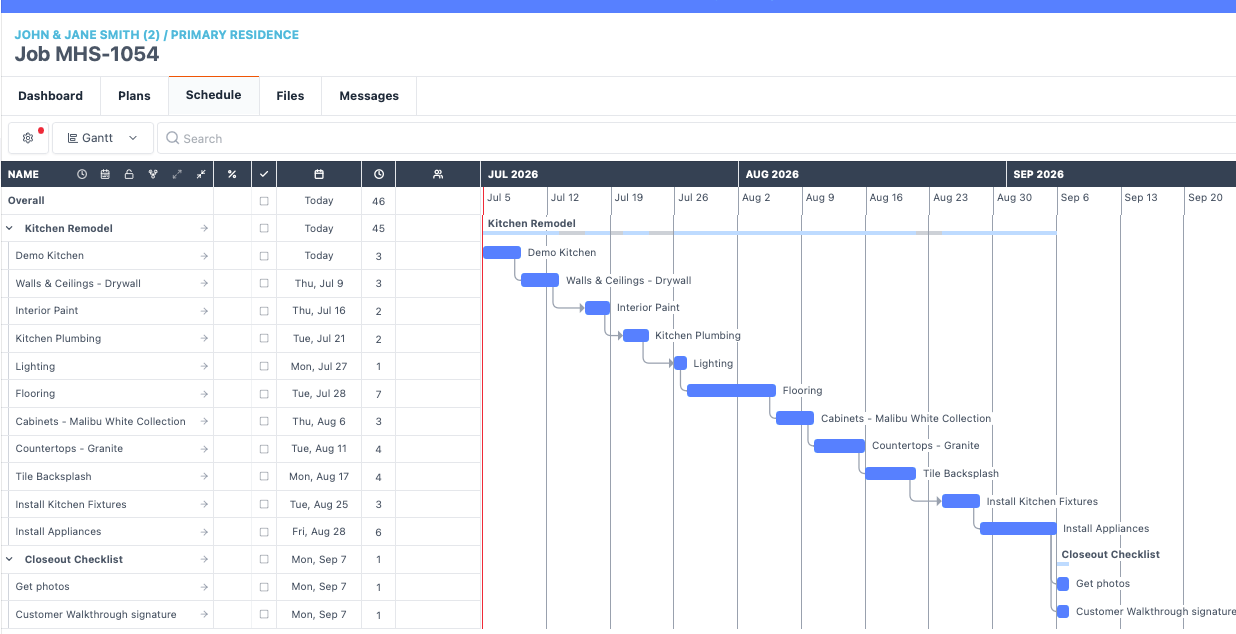
At McLeod Home Services every trade partner is scheduled into your project timeline in JobTread from the beginning — so everyone knows when they're expected on site, what phase of work they're responsible for, and what needs to be complete before they arrive.
Your Project Is Fully Built Out in JobTread
One important note for homeowners who have been through our pre-construction and design phase — you already have access to your JobTread client portal. That access began when you received your pre-construction agreement in Step 4. What changes in Step 6 is the depth of what's in your portal.
With the contract signed and the project formally activated, your full project is built out in JobTread — scope of work, budget, confirmed selections, complete project schedule, trade partner assignments, permit documentation, and all project communications. Your portal goes from a pre-construction planning tool to a fully operational project management hub.
From this point forward you have real-time visibility into every phase of your renovation — schedule updates, daily progress photos, budget tracking, and all approved change orders — without having to call anyone to find out what's happening. It's right there whenever you want to look.
Step 7 — Construction Phase
With permits approved, materials ordered, trade partners scheduled, and your project fully built out in JobTread — construction begins.
We'll dedicate next week's blog entirely to what the construction phase looks like at McLeod Home Services — the sequencing of trades, how we manage quality control, how daily communication works, and how we handle the unexpected when it comes up. But the most important thing to understand about Step 7 right now is this: everything that happens in Steps 5 and 6 exists specifically to make Step 7 go smoothly.
The projects that run on time, on budget, and on scope are not the ones that got lucky. They're the ones that were planned properly before construction ever began. The proposals were detailed. The selections were confirmed. The permits were submitted early. The materials were ordered ahead of lead times. The trades were scheduled in the right sequence.
That preparation is what a well-managed construction phase looks like before the first tool hits your home — and it's what every homeowner across Fuquay-Varina, Holly Springs, Angier, Lillington, Garner, Willow Spring, and the surrounding areas of Wake, Harnett, and Johnston Counties deserves from the contractor they hire.
If you're ready to start that first conversation about a kitchen remodel, bathroom renovation, home addition, deck, screened porch, crawl space repair, or whole-home remodel — we'd love to hear what you're thinking about.
No pressure. No obligation. Just a straightforward conversation with a licensed, insured general contractor who takes what happens before construction just as seriously as the construction itself.
